

What is a Buyer Persona in Marketing? Design Your Ideal Customer with a Free Template
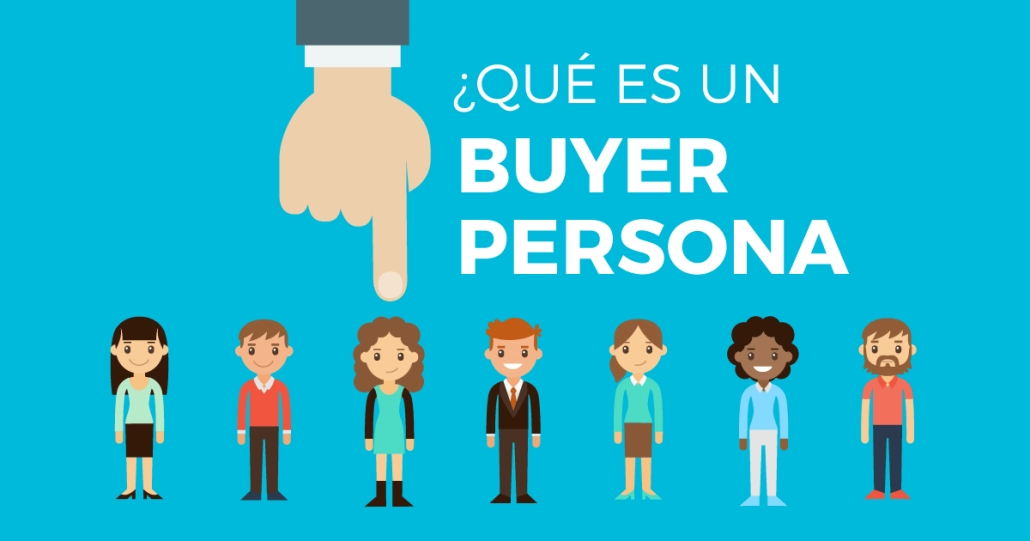
A buyer persona is a semi-fictional representation of your ideal customer based on real data and some educated guesses about demographics, behaviors, motivations, and goals.
In the context of digital marketing, creating a buyer persona helps to personalize and direct marketing resources to attract the most valuable customers for your business.
- Importance of the buyer persona in marketing
- Step by step to create your buyer presona
- Tools and resources: how to create your buyer persona?
- What is a negative buyer persona?
- Examples of buyer personas, ideal customer
- What is the difference between a buyer persona and a target audience?
- What is the difference between the buyer’s journey and the customer journey?
- Who created the concept of buyer persona?
- Tips for optimizing your buyer personas
- Tips for effective buyer personas
- Conclusión
Importance of the Buyer Persona in Marketing
Creating an effective buyer persona is crucial for any marketing strategy because it allows you to:
- Better understand your target audience, enabling you to create marketing messages and campaigns that will resonate with them.
- Direct your marketing efforts more effectively, optimizing resources and improving the ROI of your campaigns.
- Personalize content: You can generate specific content that resonates with the interests and needs of your target audience.
- Improve segmentation: They allow you to better segment your marketing campaigns to reach different buyer profiles.
- Resource optimization: Ensure that your sales and advertising team focuses their efforts efficiently.
Subscribe to OnlyNiches.NET from just €30/month and start scaling your website today.
Step by Step to Create Your Buyer Persona
Creating a buyer persona may seem like a daunting task, but with the right tools and approach, it’s a straightforward process. Here’s how to do it.
Step 1: Information Gathering
Start by collecting as much information as you can about your customer database and your target market. This includes demographic data, online behavior, interests, and any other information you can obtain through analytical tools, surveys, and interviews.
The first step is to gather actual data from your current customers. This information will give you a solid foundation to define your buyer persona.
You can obtain this data through:
- Surveys and interviews: Ask your customers about their buying habits, interests, and challenges.
- Data analysis: Use analytics tools to review your customers’ behavior on your website and social media.
- Sales team feedback: Sales representatives have valuable information about customers and their needs.
Step 2: Identification of Patterns, Trends, and Buyer Persona Types
Analyze the data to identify common patterns that may help you form specific groups of people within your database. This could include purchasing preferences, favorite media channels, age ranges, etc.
Once you have gathered the information, it’s time to analyze the data to identify patterns and trends. Look for similarities in:
- Demographics: Age, gender, geographical location, educational level, etc.
- Behavior: Purchase habits, interaction with your content, communication preferences.
- Motivations and goals: What motivates your customers to buy your product or service? What problems are they trying to solve?
Step 3: Development of Buyer Persona Profiles. Define the Buyer Persona
Using the identified information and patterns, create detailed profiles for each significant group.
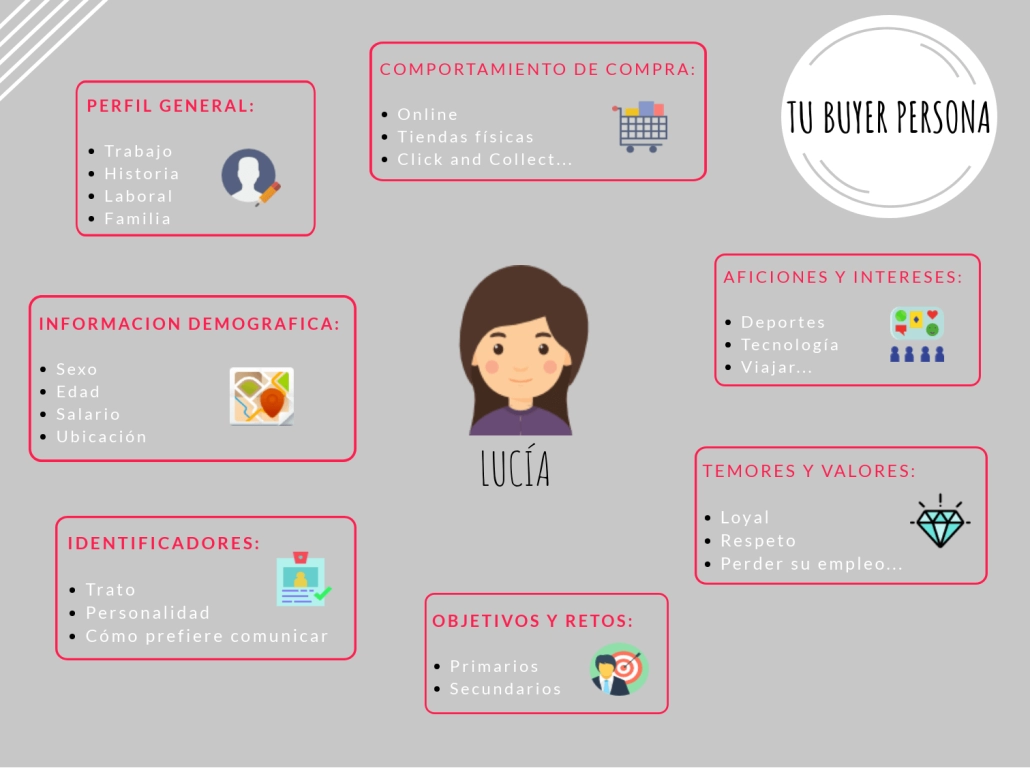
These profiles are your buyer personas. Be sure to include names, demographic details, interests, behaviors, and any other relevant information that characterizes them.
Include details like:
- Name and photo: Assign a name and a photo to make the profile more realistic for your potential customer.
- Demographic information: Age, gender, location, education, etc.
- Job position and responsibilities: This is crucial if you are in the B2B sector.
- Goals and challenges: What do your customers hope to achieve? What obstacles do they face?
- How your product or service can help: Clearly define how you can solve their problems or improve their lives.
Step 4: Application in Marketing Strategies to Create Buyer Personas
Implement these buyer personas in your marketing tactics.
Customize your marketing messages, content, products, and services to meet the specific needs and desires of each buyer persona.
Use the demographic, behavioral, emotional, and psychographic information of your buyer personas to create advertising campaigns targeted specifically at each one.
Adapt your messages on social media, emails, digital ads, and other marketing channels to resonate uniquely with all the buyer personas.
Design products and services that align with the preferences, needs, and priorities of all your buyer personas. For example, you can offer customized service packages, launch exclusive products, or generate specific educational content for each group.
Conduct surveys, interviews, and follow-ups to get continuous feedback from your buyer personas and adjust your marketing plans based on their responses.
Stay up-to-date on trends and changes in your buyer personas’ behavior to continue offering them relevant and engaging experiences.
By implementing buyer personas in your marketing methods, you can increase customer loyalty, improve customer satisfaction, and boost your conversion rates. Start personalizing your marketing today and stand out from your competition!
Step 5: Use our Template That Teaches You How to Create a Buyer Persona
Your content marketing department is often lost, many times it’s you yourself who carries out the digital marketing policy, and you don’t know how to make the buyer persona profile.
Don’t worry, you’ve come to the right article, in this format I leave you all the fields of your buyer persona and how to create it to make your life a little easier, to hit the mark with your company’s inbound marketing.
👉 Download Buyer Persona Template.
Step 6: Review and Adjustment. The Importance of Buyer Personas
The market changes constantly, so it’s important to review and adjust your buyer personas regularly. Use recent data to check if they are still accurate or if they need modifications.
A buyer persona is not a static document. As your business and market evolve, your buyer personas must also do so.
Review and update your profiles regularly to ensure they continue to be relevant.
Tools and Resources: How to Create Your Buyer Persona?
There are several tools and resources that can make it easier for you to create buyer personas, such as the templates we offer at OnlyNiches.NET, which provide structured and ready-to-use guides that will help you visualize and organize the collected information.
Additionally, the statistics section of OnlyNiches.NET has all the information about your visitors, so you can deduce the type of buyer persona ideal for you and design the target audience for a company.
Subscribe to OnlyNiches.NET from just €30/month and start scaling your website today.
What is a Negative Buyer Persona?
A negative buyer persona is a fictional profile that represents a type of customer who is not interested in acquiring a company’s products or services.
This person may have motivations or characteristics that lead them to reject the company’s value proposition, such as a lack of need for the product, lack of budget, or preference for the competition.
Identifying this buyer persona helps companies understand why some potential customers are not interested in their offer and to adjust their marketing design to attract more suitable customers.
Example of your non-customer
- Name: José
- Age: 35 years
- Profession: Freelancer
- Motivations:
- Does not trust companies or salespeople
- Has a negative view of brands and advertising
- Wants to avoid being cheated or scammed
- Seeks quick and economical solutions to his problems
- Challenges:
- Unwilling to invest in quality products
- Tends to be skeptical and distrustful
- Prone to complaining and finding faults in products
- Does not value customer service or personalized attention
EXAMPLES OF BUYER PERSONAS, IDEAL CUSTOMER
To help you better understand how to create a good buyer persona, here are some examples:
Example 1: María, the Entrepreneurial Businesswoman
- Name: María López
- Age: 35 years
- Location: Mexico City, Mexico
- Education: Bachelor’s in Business Administration
- Job Position: Owner of a small e-commerce business
- Goals: Increase online sales and expand her business nationally
- Challenges: Intense competition and lack of knowledge in digital advertising
- How we can help: Provide her with educational resources on digital communication and tools to optimize her online store.
Example 2: Juan, the IT Professional
- Name: Juan Pérez
- Age: 28 years
- Location: Bogotá, Colombia
- Education: Systems Engineer
- Job Position: Software developer at a technology company
- Goals: Stay updated with the latest technological trends and improve his technical skills
- Challenges: Lack of time to attend in-person courses and finding quality online resources
- How we can help: Offer free webinars and online tutorials on new technologies and programming languages.
What is the difference between a buyer persona and a target audience?
The main difference between a buyer persona and a target audience lies in the level of detail and customization of the information about the audience that a marketing strategy targets.
- Target Audience: Refers to a broader group of people who share general characteristics such as age, gender, socioeconomic level, interests, purchasing habits, among others. The target audience represents a more general and broad segmentation of the audience that a company addresses.
- Buyer Persona: Is a fictional and detailed representation of an ideal customer based on real data and market research. The buyer persona includes information such as their name, age, profession, consumption habits, needs, goals, challenges, etc. It represents a more precise and specific segmentation of the target audience, allowing companies to personalize their marketing and sales strategies more effectively.
In summary, while the target audience is a broader and more generalized segmentation of the audience a company targets, the buyer persona is a more detailed and personalized representation of an ideal customer that enables the creation of more effective and personalized marketing strategies.

What is the difference between the buyer’s journey and the customer journey?
The buyer’s journey refers to the process that a potential customer follows from becoming aware of a need or desire to purchase until they actually make the purchase.
This journey includes the stages of awareness, consideration, and purchase decision.
On the other hand, the customer journey refers to the process that follows once a customer has made a purchase, where the focus is on customer loyalty and ensuring their satisfaction with the purchased product or service.
This journey includes the stages of product utilization, post-sale service, and possible repurchase.
In summary, the buyer’s journey focuses on the acquisition of a product or service, while the customer journey focuses on maintaining the relationship with the customer after the purchase.
Who created the concept of buyer persona?
The concept of buyer persona was created by Alan Cooper, a software designer and the author of the book “The Inmates Are Running the Asylum.”
Cooper first used the term “persona” in the context of software design in the 1980s.
Later, the idea was adopted by marketing and businesses as a tool to better understand their customers and guide their sales and marketing strategies.
Tips for Optimizing Your Buyer Personas
Here are some additional tips to optimize your buyer personas and make the most of them:
Involve Your Entire Marketing Team
Creating buyer personas should not be the task of one person alone. Involve your entire advertising, sales, and customer service teams.
Each department can provide valuable insights to build more complete and accurate profiles.
Moreover, involving the entire team fosters collaboration and understanding of customers’ needs and desires, which can lead to more effective and customer-oriented marketing directions.
Hold meetings where each team member can share information about current and potential customers. You can also conduct surveys among employees to gather data on customer preferences and behaviors.
Additionally, it’s important to conduct interviews or surveys with real customers to validate the buyer personas and adjust them based on the feedback received.
Working as a team to create buyer personas increases the likelihood of marketing plans’ success, as they will be based on detailed and varied information, allowing for more precise segmentation and more effective communication with customers.
Use Real Data
It’s tempting to base your buyer personas on assumptions, but this can lead to mistakes.
Whenever possible, use plausible data from your current and potential customers. This includes demographic data, buying behavior, and direct feedback.
By analyzing your customers’ data, you’ll have a better understanding of who they are, what they like, and what they need.
This will allow you to create more accurate and effective buyer personas, which in turn will help you develop more targeted and appealing marketing approaches.
Moreover, using true data, you can identify trends and patterns that will help you predict your customers’ future behavior. This will allow you to anticipate their needs and offer personalized solutions that resonate with them.
In summary, basing your buyer personas on verified data will help improve the effectiveness of your marketing methods and build stronger and lasting relationships with your customers.
Segment Your Buyer Personas
Not all your customers are the same, so you likely need multiple buyer personas.
Segment your audience into different profiles to better meet their specific needs.
For example, you might have a buyer persona for small businesses and another for large corporations.
You can also segment by demographic characteristics such as age, gender, educational level, or geographic location.
Or even by buying behaviors, interests, or specific needs.
By segmenting your buyer personas, you can create more personalized and effective marketing messages and strategies for each group, thus increasing the likelihood that they will convert into customers.
Furthermore, it allows you to focus your resources and efforts on the segments that have the highest purchase potential.
Tailor Your Content to Each Buyer Persona
Once you’ve designed your buyer personas, use this information to personalize your content.
Ensure that each piece of content is directed at a specific profile, addressing their unique interests and challenges.
For example, if you have a buyer persona who is a young professional in the technology field, you can create content that focuses on the latest tech trends and tips for advancing their career.
If you have another buyer persona who is a homemaker interested in healthy cooking, you can create content that focuses on healthy recipes and tips for maintaining a balanced diet.
By personalizing your content for each of your buyer personas, you’ll increase the relevance and usefulness of your content, which in turn will increase the likelihood that your audience will engage and become potential customers.
Moreover, by showing that you understand the needs and desires of your buyer personas, you’ll build a stronger and more lasting relationship with them.
Always remember to keep your buyer personas updated and adjust your content based on any changes in their profiles or needs. This will help you maintain a precise and effective approach to reaching your audience more effectively.
Good luck!
Measure and Adjust
Finally, measure the performance of your marketing strategies based on your buyer personas.
Analyze how well they are working and adjust as needed.
Remember that creating buyer personas is a continuous process of improvement and adaptation.
To measure performance, you can use metrics such as return on investment (ROI), conversion rate, web traffic, social media engagement, among others.
Analyze this data periodically to identify which aspects are working well and which need adjustments.
If you find that any of your strategies are not delivering the expected results, do not hesitate to adjust them. You can make changes to the segmentation of your buyer personas, the messages you use, the communication channels, etc.
The goal is always to improve the effectiveness of your marketing actions.
Remember that buyer personas are just one part of your marketing strategy, so it’s important to integrate them with the rest of your initiatives to achieve optimal results.
Always stay attentive to the needs and behaviors of your buyer personas to ensure you are offering the value they are looking for.
TIPS FOR EFFECTIVE BUYER PERSONAS
- Be Specific: The more detailed your buyer persona, the more useful it will be. A detailed persona allows for more targeted and effective marketing strategies, as it provides a deeper understanding of your ideal customer’s needs and behaviors.
- Use Verified Data: Always base your buyer personas on proven information and data to ensure they are accurate and relevant. This helps ensure your marketing efforts are correctly directed and increases the effectiveness of your campaigns.
- Include Your Team: Make sure everyone on your marketing team understands and utilizes the buyer personas. This ensures that all marketing resources are aligned and working cohesively towards the same goals.
With these steps and tips, you will be well-equipped to create buyer personas that accurately represent your target audience and enhance your marketing strategies.
Conclusion
Creating buyer personas is a crucial step in any marketing strategy.
It not only helps you better understand your target audience but also optimizes your marketing campaigns by improving segmentation and content personalization.
Use the mentioned templates and tools, involve your entire team, and regularly adjust your profiles to ensure the success of your marketing efforts.
Ready to get started?
Download our free templates and start creating your buyer personas today.
Your marketing strategy will thank you!
Remember, a well-crafted buyer persona is a powerful tool that will help you connect more effectively with your ideal customers. Good luck!

Eduardo Medina
Eduardo Medina es programador y SEO, con más de 20 años de experiencia en ambos campos. Desde 2024 escribe post para OnlyNiches.NET en el que enseña a los usuarios a posicionar su web y su marca en los motores de búsqueda y redes sociales. En un mundo tan cambiante, hay que estar siempre aprendiendo y reinventándose.


Leave a Reply
Want to join the discussion?Feel free to contribute!